MB Redfined

Program Overview

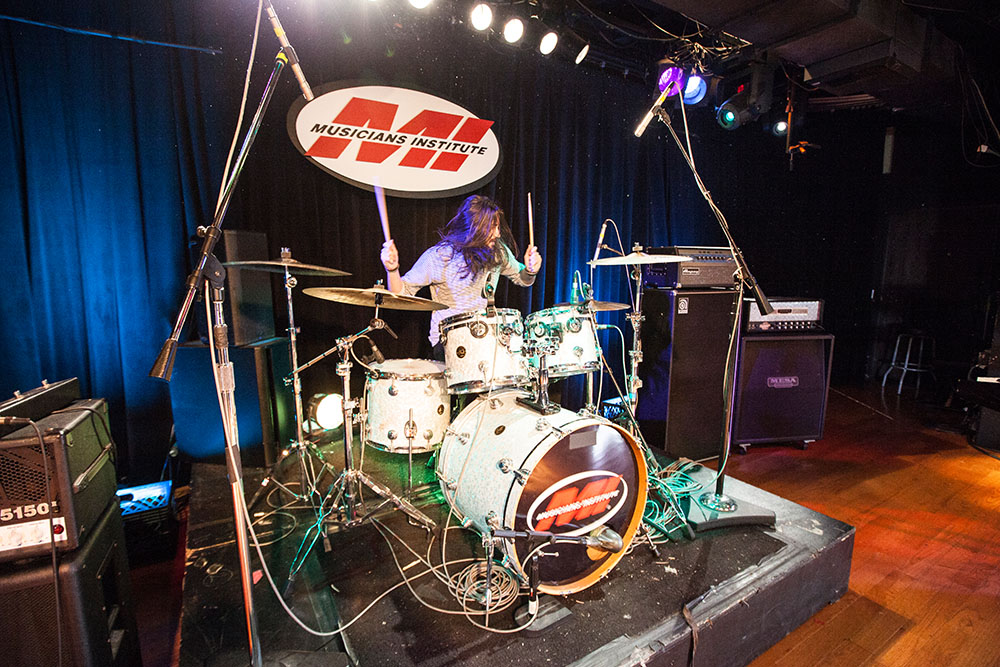
MI's Drum programs offer the world's most-imitated approach to contemporary drum education. At MI, drumming is a total-immersion experience - learn a new groove or fill in the morning and use it on stage that same afternoon under the supervision of working professionals. Gain first-hand access to some of the greatest drummers in the world through frequent clinics and concerts. The program is constantly evolving to meet the changing needs of drummers and the workplace, going beyond traditional drumming skills to include electronic drumming, digital recording, loops and sequencing. An MI Drum education gives you the real-world experience and confidence you need to meet the changing demands of the profession while you also preserve your individual vision as a player.

Bachelor of Music

PERFORMANCE-BASED EDUCATION IN CONTEMPORARY MUSIC

Musicians Institute’s challenging Bachelor of Music in Performance (Contemporary Styles) is a unique degree program combining contemporary music performance with rigorous education in traditional music disciplines. The intensive program emphasizes the development of stylistic depth, creative maturity and professional competence as part of a comprehensive program preparing students to enter the contemporary music industry. Upon completion of all requirements, students are eligible to receive the Bachelor of Music in Performance in one of five major instruments of study: Guitar, Bass, Drums, Keyboard and Vocals.

Major Area
BACH-PL Private Lesson
BACH-P151-P453 Ensembles
Various Reading
Various Instrument Study (See Below)
BACH-P104-P404 Performance
BACH-P108-P118 Sophomore Jury
BACH-P208-P218 Senior Jury

Supportive Music
BACH-P101-P801 Theory 1-8
BACH-P102-P602 Ear Training 1-6
BACH-P107-P207 Styles Survey 1-2
BACH-P121-P223 Music History 1-4
BACH-P103-P503 Contemporary Arranging 1-5
BACH-P125 Directing and Conducting 2
BACH-P109-209 Studio Recording 1-2
BACH-P124 Music Industry Studies
BACH-P126 Computer Music Applications
BACH-P120 Contemporary Music Instruction
BACH-P113-P313 Keyboard Proficiency (Required for Bass, Guitar, Drums and Voice)
BACH-V107 Diction (Required for Vocal only)

General Education Credits
Various (see “Articulation Agreement” for required credit distribution)

Electives Credits
(Elective requirements vary by instrument)
Various

INSTRUMENT STUDY

Playing Techniques 3
Techniques for performing fundamental styles and grooves, including straight eighth-note rock, straight and swing sixteenth-note funk, standard shuffles, and 4/4-meter swing. One lecture hour plus one lab hour per week for one quarter.

Playing Techniques 4
A continuation of Playing Techniques 3 with concentration on styles and grooves, including 3/4 rock, 3/4 swing, odd-meter grooves, standard Brazilian grooves, sixteenth-note funk and standard Afro-Cuban grooves. One lecture hour plus one lab hour per week for one quarter.

Playing Techniques 5
Course applies both finger and slap-style electric bass techniques to a variety of contemporary grooves, including Latin, jazz, odd-meter, funk, swing, shuffles, hip-hop and others. One lecture hour and one lab hour per week for one quarter.

Playing Techniques 6
Continued application of finger and slap-style electric bass techniques to a variety of contemporary grooves, including Afro-Cuban, jazz ballad, 4/4 swing, blues, cut-time Latin, and funk. One lecture hour and one lab hour per week for one quarter.

Fretboard Basics 3
Expand diatonic harmonic components over a wide range of notes, neck area, fingerings and hand positions, including simple intervals, diatonic triads, seventh chords, and inversions over the entire length of the neck. One lecture hour plus one lab hour per week for one quarter.

Fretboard Basics 4
Expands fingerings taught in Fretboard Basics 3 to cover chromatic harmony. One lecture hour plus one lab hour per week for one quarter.

Fretboard Improvisation 1 Concentrates on the study of modes and modal playing, major II-V-I’s and building a melodic vocabulary through the analysis of solos by Miles Davis, Sonny Rollins and Cannonball Adderly. One lecture hour plus one lab hour per week for one quarter.

Fretboard Improvisation 2
A continuation of Fretboard Improvisation 1, including a concentrated study of minor tonality, soloing over static dominant chords and continued development of a melodic vocabulary through the analysis of solos. One lecture hour plus one lab hour per week for one quarter.

Reading 3 Class covers advanced levels of chart reading through the extensive use of detailed transcriptions in a wide range of styles, including rock, funk, pop and contemporary instrumental. Concentration is on rhythmic accuracy, pitch recognition and song form. One lecture hour plus one lab hour per week for one quarter.

Reading 4
A continuation of Reading 3. One lecture hour plus one lab hour per week for one quarter.

Reading 5
Students learn contemporary chart reading skills through the extensive use of transcriptions and professionally written arrangements. Focus is placed on sight-reading, pitch and rhythm pattern recognition, position playing, and creating a cohesive sound. Class materials correlate with the All-MI Real World Live Performance Workshop. One lecture hour plus one lab hour per week for one quarter.

Reading 6
A continuation of Reading 5. One lecture hour plus one lab hour per week for one quarter.

Associate of Arts

The Associate of Arts in Performance (Drums) program includes a combination of general and instrument-specific courses designed to produce skilled, knowledgeable, stylistically and technologically versatile contemporary drummers. Courses are described below (see course catalog for specific course descriptions and other information). Combined with regular seminars, clinics, and small open counseling sessions with internationally-known drummers, the AA-Drum program provides the world's premier contemporary drumming educational experience.

GENERAL REQUIREMENTS
Degree requirements vary by instrument and include some or all of the following courses. See each emphasis for details on specific requirements.

All course descriptions include course number, title, number of credit units per quarter (multiply by number of required quarters for total credit amount), prerequisites (where applicable), description of content, and contact hours per week.

MAJOR AREA (All Instruments)

Private Lesson
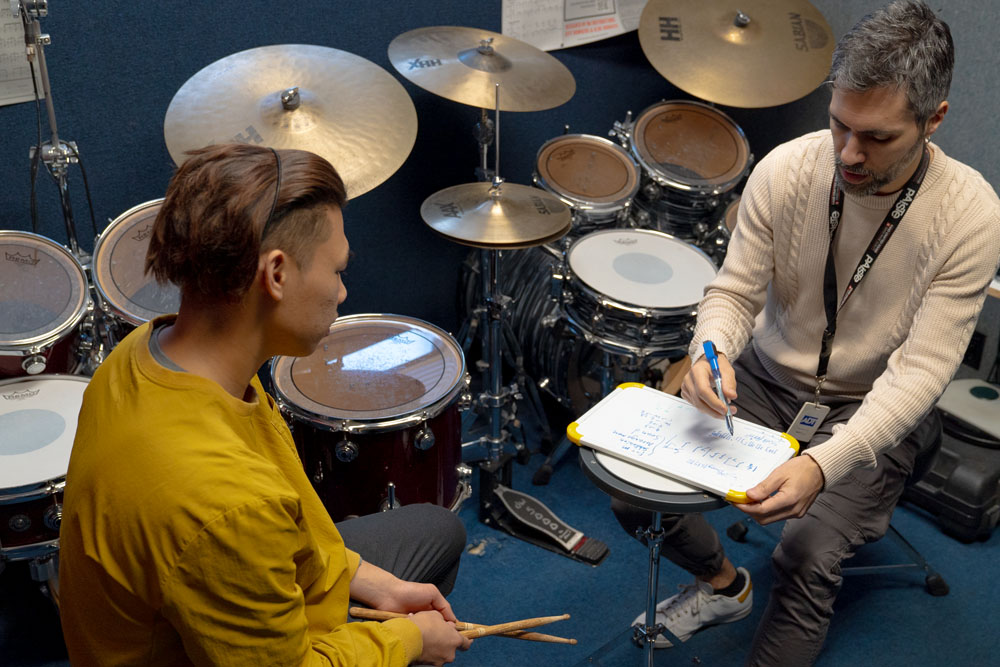
Weekly instrument lesson with an instructor who guides the student in developing technique, musicianship and style in support of core curricular goals. The instructor and student jointly determine a specific course of study depending on student needs, strengths and experience. One private lesson hour per week per quarter.

Live Performance Workshops 1-6
Students perform regularly throughout the program in a variety of styles and settings. Minimum requirement of ten performances per quarter. One ensemble hour per week per quarter.

Blues
Classic Rock
Country Rock
Modern Rock
Hard Rock
Metal
Classic R&B
Punk
Contemporary R&B
Hip-Hop
Fusion
Funk
Reggae
Latin
Billboard Hot 100

*LPW offerings vary by quarter; check current course schedule for availability

MUSICIANSHIP (Requirements vary by instrument)

Keyboard Lab 1
An introduction to the keyboard especially designed for the drummer. Covers note recognition, scales, intervals and chord construction at the keyboard as a visual and aural aid for required Theory and Ear Training classes. One hour per week for one quarter.

Keyboard Lab 2
Chords, chord progressions and basic keyboard performance. One hour per week for two quarters.

Harmony and Theory 1
Students perform regularly throughout the program in a variety of styles and settings (see section on Live Playing Workshops for overview of workshop offerings). Minimum requirement of ten performances per quarter. One ensemble hour per week per quarter.

Harmony and Theory 2
A continuation of the study of musical notation and diatonic structures, including rhythmic values, time signatures, natural minor scales and key signatures, harmonized minor scales diatonic seventh chords, and key centers. One lecture hour and one lab hour per week for one quarter.

Ear Training 1
An introduction to Ear Training as it applies to popular music. Areas of focus include matching pitch, major scale melodies, and melodic intervals in the context of examples drawn from contemporary popular music. One lecture hour and one lab hour per week for one quarter.

Ear Training 2
Topics include meter and rhythm, eighth-note phrases, sightsinging, transcribing melody and rhythm on the staff, harmonic intervals, triad qualities, and diatonic major chord progressions. One lecture hour and one lab hour per week for one quarter.

MAJOR AREA

Private Lesson
Twelve credit units required (two per quarter). See “General Requirements” for course descriptions.

Live Performance Workshops 1-6
Six credit units required (one per quarter). See “General Requirements” for course descriptions.

Playing Techniques 1
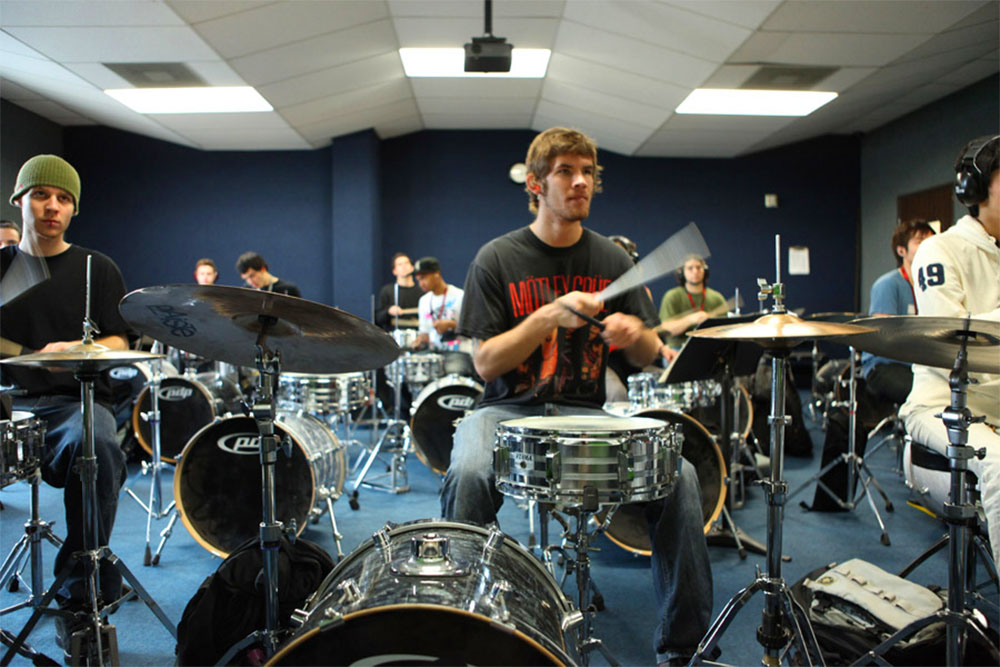
Introduction to hand technique and essential rudiments. One lecture hour plus one lab hour per week for one quarter.

Playing Techniques 2
Continuation of Playing Techniques 1 with an emphasis on developing dynamic control. One lecture hour plus one lab hour per week for one quarter.

Playing Techniques 3
Concentrates on effective timekeeping, development of speed and dexterity, economy of motion, body balance and eliminating bad habits as well as the application of drum set rudiments. One lecture hour plus one lab hour per week for one quarter.

Playing Techniques 4
Emphasizes interpretation and performance of snare drum solos and development of four-way independence. One lecture hour plus one lab hour per week for one quarter.

Playing Techniques 5
Class focuses on more advanced rudiments and their application to the drum set in a variety of musical styles as well as advanced snare drum solos and drum set solo transcriptions. One lecture hour plus one lab hour per week for one quarter.

Playing Techniques 6
Concepts and techniques learned in Playing Techniques 1-5 culminate in student performances of original snare etudes and drum set etudes. One lecture hour plus one lab hour per week for one quarter.

Rhythm Section Workshop 1
Students develop fundamental technical approaches to a variety of popular styles through weekly live performance. Concentration is placed on listening, dynamics, awareness of song form, basic chart reading, instrument setup, and sound. Two lecture-ensemble hours per week for one quarter.

Rhythm Section Workshop 2
Continuation of ensemble performing experience, including intermediate-level chart reading as well as further development of practical performing techniques, such as giving and following cues, instrument setup, sound, and stage presence. Two lecture-ensemble hours per week for one quarter.

Rhythm Section Workshop 3
Ensemble performance emphasizing stylistic rhythm section textures and applied techniques. Emphasis is placed on handling variations in typical song form, improving chart-reading skills, and taking a leadership role within the group. Two lecture/ensemble hours per week for one quarter.

Rhythm Section Workshop 4
Ensemble performance emphasizing applied techniques and advanced concepts, such as odd meters and metric modulation. Emphasis is also placed on handling variations in typical song form, improving chart reading skills and developing time feel. Two lecture/ensemble hours per week for one quarter.

Ensemble Techniques 1
Course deals with common techniques used by drummers in small and large-group performance. The focus is on reading and executing written rhythmic phrases in jazz and rock styles, including section and ensemble figures. One lecture hour plus one lab hour per week for one quarter.

Ensemble Techniques 2
Continued development of performance techniques with emphasis on execution of written rhythmic phrases in jazz, rock, funk, Latin and odd-meter styles, including section and ensemble figures, chart terminology and form, phrasing and stylistic interpretation, soloing concepts and solo fills. One lecture hour plus one lab hour per week for one quarter.

Music Minus One Performance 1
Drummers play to sequenced tracks of popular songs minus drums. The emphasis is on “locking in” with the track; includes beginning level chart reading. One ensemble hour per week for one quarter.

Music Minus One Performance 2
Stylistic performance expands from pop and jazz to include Latin and reggae styles as well as soloing. Includes intermediate-level chart reading. One ensemble hour per week for one quarter.

Digital Drumming 1
This comprehensive course is designed to equip drummers to utilize contemporary technology by providing a working knowledge of MIDI sequencing, digital audio recording software, drum loop creation and application, and custom sample creation. Students also learn to perform with loops and backing tracks. Two lecture hours and one lab hour per week for one quarter.

Digital Drumming 2
Further training in MIDI sequencing, digital audio recording, and sample creation as well as drum triggering, and designing, creating, and wiring an electronic rig for live use. Students perform with loops and backing tracks while learning how to complement tracks with their playing and adjust their time feel in order to “lock in.” Two lecture hours and one lab hour per week for one quarter.

Advanced Drumming 1: Jazz
This class explores and demonstrates the basic elements of jazz drumming. Techniques include ride patterns and left-hand comping, basic independence and coordination, and ensemble interaction. One lecture hour plus one lab hour per week for one quarter.

Advanced Drumming 2: Jazz
Explores the historical, stylistic and technical evolution of jazz from Dixieland to Bebop and beyond, with focus on group interaction, jazz soloing on various song forms, up-tempo swing concepts, cymbal turnarounds, 3/4 time, advanced independence and four-way jazz coordination. One lecture hour plus one lab hour per week for one quarter.

Advanced Drumming 3: Latin
Class develops authentic stylistic hand and foot techniques through listening, demonstration and classroom practice, with emphasis on popular Brazilian styles, including Bossa Nova and Samba. One lecture hour plus one lab hour per week for one quarter.

Advanced Drumming 4: Latin
Continuation of Latin drumming techniques with emphasis on Afro-Cuban styles, including Cha Cha, Mambo, Mozambique and others. One lecture hour plus one lab hour per week for one quarter.

Developing Your Groove 1
The goal of this course is to help drummers apply fundamental rhythms to the drum set in order to improve time, feel, independence and sound. Coordination drills in rock and jazz styles are introduced and performed in class. One lecture/ ensemble hour per week for one quarter.

Developing Your Groove 2
Furher groove development with increasing difficulty of rhythms and four-way independence. Coordination drills applying to all styles of music, including rock, funk, jazz and Latin, dramatically improve time, feel, independence and sound. One lecture/ ensemble hour per week for one quarter.

Contemporary Drum Concepts 1
Learn the attitude and technique of rock drumming through listening examples and transcriptions that expose students to drummers who have made important contributions to the style. Techniques include warm-ups, motion exercises, and single and double bass drum studies. One lecture hour plus one lab hour per week for one quarter.

Contemporary Drum Concepts 2
Focuses on the continued development of performance skills, including groove development, soloing concepts, more advanced single and double bass drum application and sound production. One lecture hour plus one lab hour per week for one quarter.

Odd Meter 1
Students develop facility with odd-meter rhythmic phrases applied to both the drum set and hand drums. Rhythmic phrasing drills develop composite meter performance and technique. One lecture hour plus one lab per week for one quarter.

Odd Meter 2
Advanced odd-meter rhythmic phrasing, including techniques for analyzing and applying rhythms in any rhythmic subdivision or meter. Topics also include technique, time/feel, song form, and phrasing. One lecture hour plus one lab per week for one quarter.

Studio Drumming 1
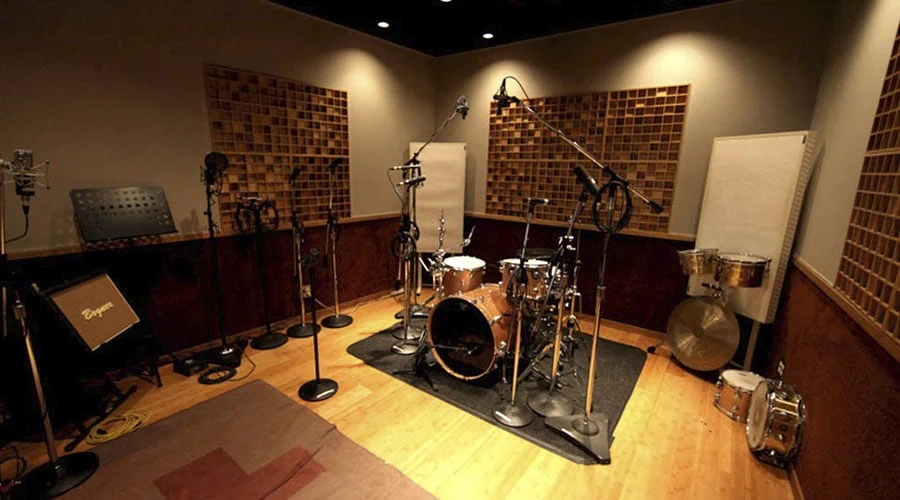
This “real world” approach to recording covers all facets of the recording experience for drummers whether they work in original bands or as independent studio musicians. In a 24-track Avid Pro Tools© HD studio, students perform in a variety of musical situations, including developing drum parts, sight-reading charts, performing with backing tracks, overdubbing and punching in, and learning to lock in with loops and tracks. Studio etiquette and sound development are also covered. Each student receives an HD video of their final performances. Two lecture hours per week for one quarter.

Studio Drumming 2
A continuation of studio drumming techniques and experiences, including advanced styles, such as odd-meter performance and soloing. Each student receives an HD video of their final performance. Two lecture hours per week for one quarter.

Reading 1
Fundamentals of single-line and drum set reading. Students learn basic rhythmic theory, develop sight-reading skills, and interpret essential rhythmic figures. Two lecture hours per week for one quarter.

Reading 2
Introduction of time signature studies, note-value relationships, counting, and subdivision exercises. Also includes interpreting rhythms in different styles at the drum set, independence studies and chart reading. Two lecture hours per week for one quarter.

Reading 3
The emphasis is on time signature reading studies, counting and subdivision exercises and applications as well as notevalue relationships. Also included is interpretation of rhythms in different styles, independence studies and chart reading. One lecture hour and one lab hour per week for one quarter.

Reading 4
Reading compound time signatures, changing meters, value indicators and abnormal groupings. One lecture hour and one lab hour per week for one quarter.

Reading 5
Interpretation of sixteenth-note figures, snare drum reading and etudes in changing meters in preparation for studio recording. One lecture hour and one lab hour per week for one quarter.

Reading 6
Advanced reading skills include orchestral snare drum etudes, reading drum set charts with style and meter changes, and multi-tom reading in preparation for studio recording. One lecture hour and one lab hour per week for one quarter.

MUSICIANSHIP

Keyboard Lab 1
An introduction to the keyboard especially designed for the drummer. Covers note recognition, scales, intervals and chord construction at the keyboard as a visual and aural aid for required Theory and Ear Training classes. One hour per week for one quarter.

Keyboard Lab 2
Chords, chord progressions and basic keyboard performance. One hour per week for two quarters.

Harmony and Theory 1–2
Three credit units required (one and one-half per quarter). See General Requirements for course descriptions.

Ear Training 1–2
Three credit units required (one and one-half per quarter). See General Requirements for course descriptions.

ELECTIVES

Basic Caribbean Drumset
Latin Percussion - Afro-Cuban
Latin Percussion – Brazilian
Early Studio Drumming Masters
Inside Studio Drumming
Double Bass Drum Workout
Fill Fest
How to Practice
Timekeeping
Funk Drums – Classic
Funk Drums – Modern
Latin/Funk Connection
Bebop and Beyond
Analysis of Great Grooves
Drum Transcription and Ear Training
Drum Solo Analysis, Concepts and Performance
Bridging the Gaps
Duets
Chop Busters 1
Chop Busters 2
New Orleans Drumming
Advanced Drum Concepts 1
Advanced Drum Concepts 2

AA Degree Emphasis

Associate of Arts students in instrument performance programs (Bass, Drums, Guitar, Keyboard Technology, Vocals) may opt for a combined course of study which is a combination of the performance program and a music industry program (Audio Engineering, Film, Guitar Craft, Music Business, Independent Artist).

Enrollment in such programs is dependent upon admission approval and space availability.

*Associate programs are vocational and do not include General Education requirements or specific preparation for study at the Baccalaureate level.

Certificate

The four-quarter, 60 credit-unit Certificate in Performance (Drums) is the perfect program for contemporary drummers. The unique, intensive curriculum develops professional-level skill, experience and confidence while preserving your individual vision as a player. Internationally-recognized instructors not only train you in traditional and innovative playing styles and techniques, but show you how to work with leading-edge technology. Frequent clinics and concerts provide first-hand access to a cross-section of the greatest drummers in the world. The Drum Program at MI gives you the tools and playing experience you need to achieve your creative and career goals as a contemporary drummer.

GENERAL REQUIREMENTS
Degree requirements vary by instrument and include some or all of the following courses. See each emphasis for details on specific requirements.

All course descriptions include course number, title, number of credit units per quarter (multiply by number of required quarters for total credit amount), prerequisites (where applicable), description of content, and contact hours per week.

MAJOR AREA (All Instruments)

Private Lesson
Weekly instrument lesson with an instructor who guides the student in developing technique, musicianship and style in support of core curricular goals. The instructor and student jointly determine a specific course of study depending on student needs, strengths and experience. One private lesson hour per week per quarter.

Live Performance Workshops 1-4
Students perform regularly throughout the program in a variety of styles and settings. Minimum requirement of ten performances per quarter. One ensemble hour per week per quarter.

Blues
Classic Rock
Country Rock
Modern Rock
Hard Rock
Metal
Classic R&B
Punk
Contemporary R&B
Hip-Hop
Fusion
Funk
Reggae
Latin
Billboard Hot 100

*LPW offerings vary by quarter; check current course schedule for availability

MUSICIANSHIP (Requirements vary by instrument)

Keyboard Lab 1
An introduction to the keyboard especially designed for the drummer. Covers note recognition, scales, intervals and chord construction at the keyboard as a visual and aural aid for required Theory and Ear Training classes. One hour per week for one quarter.

Keyboard Lab 2
Chords, chord progressions and basic keyboard performance. One hour per week for two quarters.

Harmony and Theory 1
Students perform regularly throughout the program in a variety of styles and settings (see section on Live Playing Workshops for overview of workshop offerings). Minimum requirement of ten performances per quarter. One ensemble hour per week per quarter.

Harmony and Theory 2
A continuation of the study of musical notation and diatonic structures, including rhythmic values, time signatures, natural minor scales and key signatures, harmonized minor scales diatonic seventh chords, and key centers. One lecture hour and one lab hour per week for one quarter.

Ear Training 1
An introduction to Ear Training as it applies to popular music. Areas of focus include matching pitch, major scale melodies, and melodic intervals in the context of examples drawn from contemporary popular music. One lecture hour and one lab hour per week for one quarter.

Ear Training 2
Topics include meter and rhythm, eighth-note phrases, sightsinging, transcribing melody and rhythm on the staff, harmonic intervals, triad qualities, and diatonic major chord progressions. One lecture hour and one lab hour per week for one quarter.

MAJOR AREA

Private Lesson
Twelve credit units required (two per quarter). See “General Requirements” for course descriptions.

Live Performance Workshops 1-4
Six credit units required (one per quarter). See “General Requirements” for course descriptions.

Playing Techniques 1
Introduction to hand technique and essential rudiments. One lecture hour plus one lab hour per week for one quarter.

Playing Techniques 2
Continuation of Playing Techniques 1 with an emphasis on developing dynamic control. One lecture hour plus one lab hour per week for one quarter.

Playing Techniques 3
Concentrates on effective timekeeping, development of speed and dexterity, economy of motion, body balance and eliminating bad habits as well as the application of drum set rudiments. One lecture hour plus one lab hour per week for one quarter.

Playing Techniques 4
Emphasizes interpretation and performance of snare drum solos and development of four-way independence. One lecture hour plus one lab hour per week for one quarter.

Rhythm Section Workshop 1
Students develop fundamental technical approaches to a variety of popular styles through weekly live performance. Concentration is placed on listening, dynamics, awareness of song form, basic chart reading, instrument setup, and sound. Two lecture-ensemble hours per week for one quarter.

Rhythm Section Workshop 2
Continuation of ensemble performing experience, including intermediate-level chart reading as well as further development of practical performing techniques, such as giving and following cues, instrument setup, sound, and stage presence. Two lecture-ensemble hours per week for one quarter.

Rhythm Section Workshop 3
Ensemble performance emphasizing stylistic rhythm section textures and applied techniques. Emphasis is placed on handling variations in typical song form, improving chart-reading skills, and taking a leadership role within the group. Two lecture/ensemble hours per week for one quarter.

Rhythm Section Workshop 4
Ensemble performance emphasizing applied techniques and advanced concepts, such as odd meters and metric modulation. Emphasis is also placed on handling variations in typical song form, improving chart reading skills and developing time feel. Two lecture/ensemble hours per week for one quarter.

Ensemble Techniques 1
Course deals with common techniques used by drummers in small and large-group performance. The focus is on reading and executing written rhythmic phrases in jazz and rock styles, including section and ensemble figures. One lecture hour plus one lab hour per week for one quarter.

Ensemble Techniques 2
Continued development of performance techniques with emphasis on execution of written rhythmic phrases in jazz, rock, funk, Latin and odd-meter styles, including section and ensemble figures, chart terminology and form, phrasing and stylistic interpretation, soloing concepts and solo fills. One lecture hour plus one lab hour per week for one quarter.

Music Minus One Performance 1
Drummers play to sequenced tracks of popular songs minus drums. The emphasis is on “locking in” with the track; includes beginning level chart reading. One ensemble hour per week for one quarter.

Music Minus One Performance 2
Stylistic performance expands from pop and jazz to include Latin and reggae styles as well as soloing. Includes intermediate-level chart reading. One ensemble hour per week for one quarter.

Digital Drumming 1
This comprehensive course is designed to equip drummers to utilize contemporary technology by providing a working knowledge of MIDI sequencing, digital audio recording software, drum loop creation and application, and custom sample creation. Students also learn to perform with loops and backing tracks. Two lecture hours and one lab hour per week for one quarter.

Digital Drumming 2
Further training in MIDI sequencing, digital audio recording, and sample creation as well as drum triggering, and designing, creating, and wiring an electronic rig for live use. Students perform with loops and backing tracks while learning how to complement tracks with their playing and adjust their time feel in order to “lock in.” Two lecture hours and one lab hour per week for one quarter.

Advanced Drumming 1: Jazz
This class explores and demonstrates the basic elements of jazz drumming. Techniques include ride patterns and left-hand comping, basic independence and coordination, and ensemble interaction. One lecture hour plus one lab hour per week for one quarter.

Advanced Drumming 2: Jazz
Explores the historical, stylistic and technical evolution of jazz from Dixieland to Bebop and beyond, with focus on group interaction, jazz soloing on various song forms, up-tempo swing concepts, cymbal turnarounds, 3/4 time, advanced independence and four-way jazz coordination. One lecture hour plus one lab hour per week for one quarter.

Advanced Drumming 3: Latin
Class develops authentic stylistic hand and foot techniques through listening, demonstration and classroom practice, with emphasis on popular Brazilian styles, including Bossa Nova and Samba. One lecture hour plus one lab hour per week for one quarter.

Advanced Drumming 4: Latin
Continuation of Latin drumming techniques with emphasis on Afro-Cuban styles, including Cha Cha, Mambo, Mozambique and others. One lecture hour plus one lab hour per week for one quarter.

Developing Your Groove 1
The goal of this course is to help drummers apply fundamental rhythms to the drum set in order to improve time, feel, independence and sound. Coordination drills in rock and jazz styles are introduced and performed in class. One lecture/ ensemble hour per week for one quarter.

Developing Your Groove 2
Further groove development with increasing difficulty of rhythms and four-way independence. Coordination drills applying to all styles of music, including rock, funk, jazz and Latin, dramatically improve time, feel, independence and sound. One lecture/ ensemble hour per week for one quarter.

Contemporary Drum Concepts 1
Learn the attitude and technique of rock drumming through listening examples and transcriptions that expose students to drummers who have made important contributions to the style. Techniques include warm-ups, motion exercises, and single and double bass drum studies. One lecture hour plus one lab hour per week for one quarter.

Contemporary Drum Concepts 2
Focuses on the continued development of performance skills, including groove development, soloing concepts, more advanced single and double bass drum application and sound production. One lecture hour plus one lab hour per week for one quarter.

Odd Meter 1
Students develop facility with odd-meter rhythmic phrases applied to both the drum set and hand drums. Rhythmic phrasing drills develop composite meter performance and technique. One lecture hour plus one lab per week for one quarter.

Odd Meter 2
Advanced odd-meter rhythmic phrasing, including techniques for analyzing and applying rhythms in any rhythmic subdivision or meter. Topics also include technique, time/feel, song form, and phrasing. One lecture hour plus one lab per week for one quarter.

Studio Drumming 1
This “real world” approach to recording covers all facets of the recording experience for drummers whether they work in original bands or as independent studio musicians. In a 24-track Avid Pro Tools© HD studio, students perform in a variety of musical situations, including developing drum parts, sight-reading charts, performing with backing tracks, overdubbing and punching in, and learning to lock in with loops and tracks. Studio etiquette and sound development are also covered. Each student receives an HD video of their final performances. Two lecture hours per week for one quarter.

Studio Drumming 2
A continuation of studio drumming techniques and experiences, including advanced styles, such as odd-meter performance and soloing. Each student receives an HD video of their final performance. Two lecture hours per week for one quarter.

Reading 1
Fundamentals of single-line and drum set reading. Students learn basic rhythmic theory, develop sight-reading skills, and interpret essential rhythmic figures. Two lecture hours per week for one quarter.

Reading 2
Introduction of time signature studies, note-value relationships, counting, and subdivision exercises. Also includes interpreting rhythms in different styles at the drum set, independence studies and chart reading. Two lecture hours per week for one quarter.

Reading 3
The emphasis is on time signature reading studies, counting and subdivision exercises and applications as well as notevalue relationships. Also included is interpretation of rhythms in different styles, independence studies and chart reading. One lecture hour and one lab hour per week for one quarter.

Reading 4
Reading compound time signatures, changing meters, value indicators and abnormal groupings. One lecture hour and one lab hour per week for one quarter.

MUSICIANSHIP

Keyboard Lab 1
An introduction to the keyboard especially designed for the drummer. Covers note recognition, scales, intervals and chord construction at the keyboard as a visual and aural aid for required Theory and Ear Training classes. One hour per week for one quarter.

Keyboard Lab 2
Chords, chord progressions and basic keyboard performance. One hour per week for two quarters.

Harmony and Theory 1–2
Three credit units required (one and one-half per quarter). See General Requirements for course descriptions.

Ear Training 1–2
Three credit units required (one and one-half per quarter). See General Requirements for course descriptions.

ELECTIVES

Basic Caribbean Drumset
Latin Percussion - Afro-Cuban
Latin Percussion – Brazilian
Early Studio Drumming Masters
Inside Studio Drumming
Double Bass Drum Workout
Fill Fest
How to Practice
Timekeeping
Funk Drums – Classic
Funk Drums – Modern
Latin/Funk Connection
Bebop and Beyond
Analysis of Great Grooves
Drum Transcription and Ear Training
Drum Solo Analysis, Concepts and Performance
Bridging the Gaps
Duets
Chop Busters 1
Chop Busters 2
New Orleans Drumming
Advanced Drum Concepts 1

Non-Certificate

ENCORE

The Encore Program (Non-Certificate Training in Music Performance) is designed to allow students to create a full-time, ten-week program by choosing from available lessons, classes, performance workshops and other activities. Enrollment is available at the beginning of any quarter and may be repeated for additional quarters.

THE ENCORE PROGRAM INCLUDES:

Schedule
Based on an initial evaluation, the Encore Coordinator provides each student with a list of available courses that are appropriate to the student’s level of knowledge and skill. From that list, the student creates a class schedule equal to a full-time credit load of fifteen units.

Note: Course offerings vary by quarter and some courses and programs are not available for Encore enrollment. A list of available courses will be provided to each student by the Encore Coordinator prior to registration. To confirm the availability of specific courses, please consult with the Encore Coordinator prior to enrollment.

Private Lessons
Every instrument Encore session includes weekly, one-hour private lessons on the student’s primary instrument. Instructor and student jointly develop a lesson plan based on the student’s particular interests and the instructor provides general guidance throughout the program.

Note: Requests for private lessons with a specific instructor are subject to instructor availability.

Access
Encore enrollment includes 24-hour access to MI’s facilities for practice and rehearsal, access to extra-curricular activities and the library, and admission to clinics and seminars offered during the student’s period of enrollment.

IMPORTANT ADDITIONAL INFORMATION:

Financial Aid – Encore is not eligible for State or Federal financial aid.
January and July enrollments – Most Core classes available to entering Encore students in performance programs during January and July quarters are at intermediate-to-advanced levels. January or July enrollment is not advised for beginning-level Encore students.
Materials – Encore students are entitled to receive curriculum and other materials applicable to courses included in their official course schedule only.
Fees – Encore students are responsible for all applicable fees; see “Tuition and Fees” for specific information.
Course Credit – Courses taken during an Encore session do not earn course credit. Attendance or completion of any course does not guarantee subsequent advanced placement in a Certificate or Degree program.

Pictures