
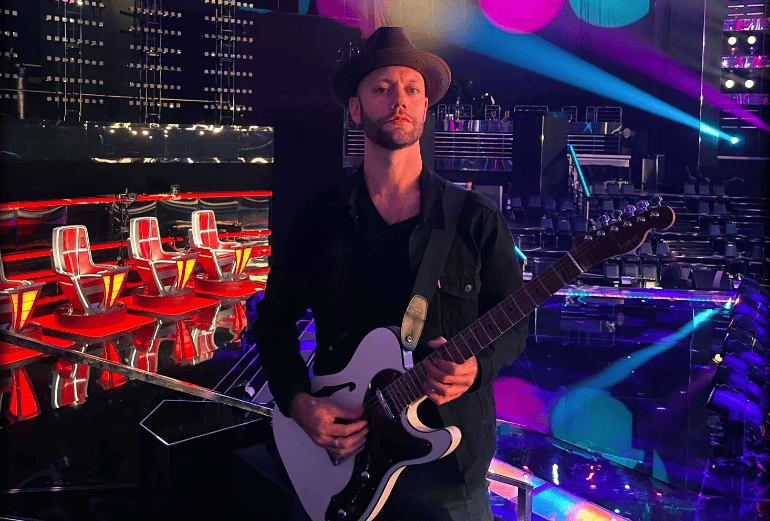
Building a career as a professional musician takes more than being great at your instrument. You need to learn music quickly, adapt to different artists and styles, perform under pressure, build relationships and be ready when the right opportunity arrives. For MI graduate Dory Lobel, those skills became the foundation of a career spanning more than two decades.
Lobel is a guitarist, producer, songwriter and musical director who spent 13 years working on NBC’s The Voice, first as a lead guitarist and later as a musical director. His career has also included work with artists including Enrique Iglesias, Backstreet Boys, Colbie Caillat, Hilary Duff and Jesse McCartney in roles ranging from guitarist and musical director to songwriter and producer.
But before those opportunities, Lobel moved to Los Angeles for one specific reason: to attend Musicians Institute.

Blog Post
"*" indicates required fields
By submitting this form, I authorize Musicians Institute (MI) to make or allow the placement of calls, emails, and texts to me at the phone number that I have provided, including through the use of automated technology, or a prerecorded or artificial voice. I understand that I am not required to provide my phone number as a condition of purchasing any property, goods, or services. I agree to the terms of MI’s Privacy Policy. MI will not sell or rent your information to third parties, and you may unsubscribe at any time.
Moving to Los Angeles to Study Guitar at MI
Lobel grew up admiring guitarists and the music scene surrounding Hollywood. That eventually led him to MI’s Guitar Institute of Technology (GIT).
“I actually moved here to LA specifically for MI and had the best time of my life,” Lobel says.
For Lobel, MI wasn’t about starting from zero. He was already a working guitarist who had played gigs and performed live. What he needed was a way to fill the gaps in his musicianship and prepare for the demands of a professional music career.
Filling the Gaps in Music Theory, Ear Training and Musicianship
Like many guitarists, Lobel says his musical education didn’t follow a traditional classical or jazz path.
“I was really a player,” he explains. “I used to gig, but I had so many things that I didn’t know how to do.”
At MI, he focused on areas including music theory, ear training and different musical styles, while learning from working musicians and faculty.
That combination mattered because becoming a professional guitarist often means doing much more than playing the music you already know.
A working musician may have to walk into an audition, learn unfamiliar material, read a chart, change styles, follow a musical director or prepare a large amount of music on a tight deadline. Lobel experienced that firsthand at MI.
The MI Class That Prepared Dory Lobel for The Voice
One experience stands out when Lobel looks back at his time at MI.
He remembers participating in a the Real World LPWs (Live Performance Workshops), where students were given unfamiliar music and expected to get onstage and perform it.
“They throw music at you that you’ve never heard. You have to go on stage and play it,” Lobel recalls.
Years later, that exercise would feel remarkably familiar.
“That’s literally what I do on The Voice. That’s what prepared me for that.”
It’s a direct example of how practicing adaptability can translate into a professional music career.
On a production like The Voice, musicians need more than instrumental technique. They may need to learn songs quickly, move between genres, respond to changes and consistently deliver under the pressure of a major television production.
Those are skills that can be practiced.
What Does It Take to Become a Professional Musician?
After more than 20 years in the industry, Lobel emphasizes versatility. He describes the goal of his MI experience as learning how to “get gigs, get auditions, know what to do, know how to learn music very quickly” and adapt to different professional situations.
That adaptability is reflected in Lobel’s own career.
Rather than staying in one lane, he has worked as a guitarist, songwriter, producer and musical director. His career demonstrates how developing complementary skills can create more ways to work in the music industry.
For aspiring musicians, that can mean expanding beyond instrumental technique into areas such as ear training, theory, songwriting, production, arranging, technology and musical direction.
Why Networking Matters in the Music Industry
Musical ability is only one part of building a sustainable career.
Lobel identifies three things that made his experience at MI particularly valuable: the education and facilities, the opportunity to build a network, and studying in Los Angeles.
Being surrounded by other musicians means the people you meet while studying can eventually become collaborators, bandmates, producers, engineers, musical directors or the person recommending you for a gig.
“You’re building your network and you’re actually meeting the people that could quite literally take you and start your career,” Lobel says. “You can get your first gig by being here.”
That makes learning how to collaborate and build genuine professional relationships another important part of preparing for a career in music.
Building the Skills for a Career in Music
There is no single path to becoming a professional musician. Lobel is also clear that building a career in music is competitive and requires dedication and passion.
But preparation can put musicians in a better position when opportunities arrive.
For Lobel, that preparation included developing his musicianship, filling gaps in his knowledge, performing with other musicians, learning to adapt quickly and building a professional network.
“I owe so much of my career to Musicians Institute,” he says.
For aspiring guitarists and musicians, his story offers a useful reminder: the goal isn’t simply to become a better player. It’s to become the kind of musician who is ready to work.